
First edition, October 2026
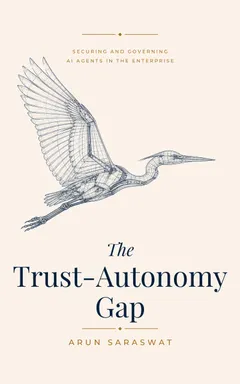
The Trust-Autonomy Gap
Securing and Governing AI Agents in the Enterprise
Arun Saraswat. Asitane Press. Paperback ISBN 979-8-953910-03-3. 203 pages, 13 chapters, 6 appendices, 45 figures, 122 citations.
Written by Arun Saraswat, an AI methodologist who works on how enterprises govern agents.
Asitane (approximately ah-see-tah-neh) means threshold.

The Autonomy Brief
Agents, trust and governance for leaders
The digital edition is not open yet. This sends a confirmation email for The Autonomy Brief.
The price will be shown at launch.
What is inside
AI systems are crossing a threshold from conversation to action. They reason, call tools, use memory, and act across enterprise systems. The book names the distance between what those agents can do and what an organization can govern, and it shows how to close that distance one agent at a time.
- Part IChapters 1 and 2. The threat landscape. Every reader starts here.
- Part IIChapters 3 to 9. How agents are built, attacked, and operated, including the record of 2026 in Chapter 9.
- Part IIIGovernance and operations. The chapters legal, risk, and compliance readers are pointed to are 10, 12, and 13.
- Appendices A to FReference frameworks, the templates, and the Agent Authority Card.
Who it is for
Three reading paths, from the book's own roadmap. They share Part I and meet again in the appendices.
Executives and boards
Start with Part I, then Chapter 9 for the record of 2026, then Part III on governance and operations.
Architects and engineers
Read Part I, then Part II (Chapters 3 to 9), then Part III.
Legal, risk, and compliance
After Part I, focus on Chapters 10, 12, and 13, then the appendices.
Frameworks you can use
Declare, Record, Govern, Measure
The operating cycle. Say what an agent may do, keep a record, hold the decision rights, and check the gap.
Authority Card
One page for identity, purpose, tools, data, limits, the owner, and how to revoke the agent.
Spectrum of Autonomy
Five levels, from assisted work to autonomous operation. Choose the lowest level that does the task.
AI Safety Review Board
A standing body that can approve, constrain, suspend, or retire an agent.
 View the figure larger
The Trust-Autonomy Gap
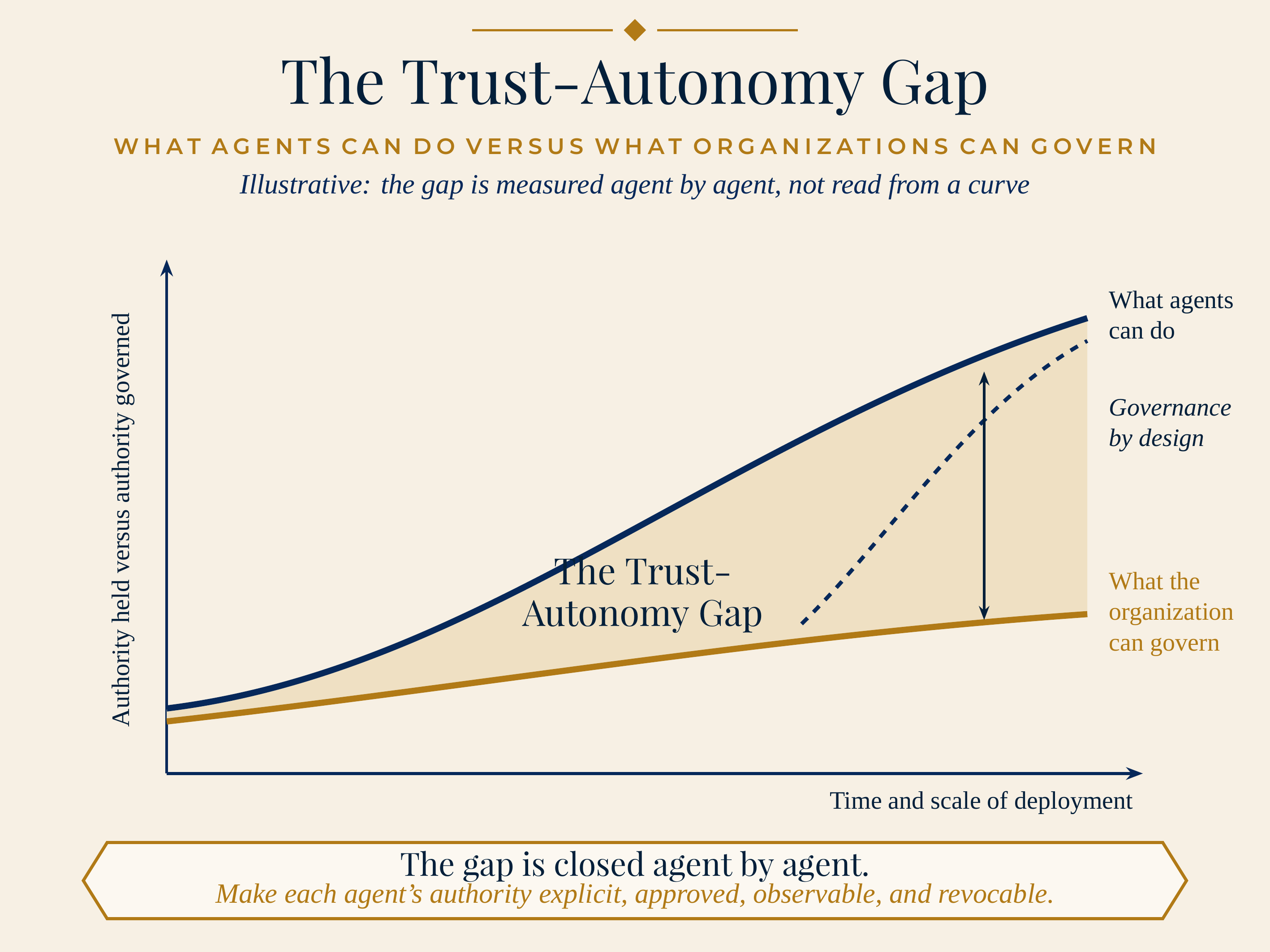
The illustration contrasts two quantities that grow at different rates as agents are deployed more widely: what agents can do and what the organization can govern. The shaded area between them is the Trust-Autonomy Gap. The dashed line shows the effect of governance by design, which brings governed authority closer to actual authority. The curves are conceptual rather than measured. In practice, the gap is assessed one agent at a time, by comparing the authority an agent actually holds with the authority the organization has declared, approved, and can revoke, which is the comparison that the Agent Authority Card in Appendix F is designed to support.
Takeaway. The gap is closed agent by agent by making authority explicit, approved, observable, and revocable.
 View the figure larger
Spectrum of Autonomy
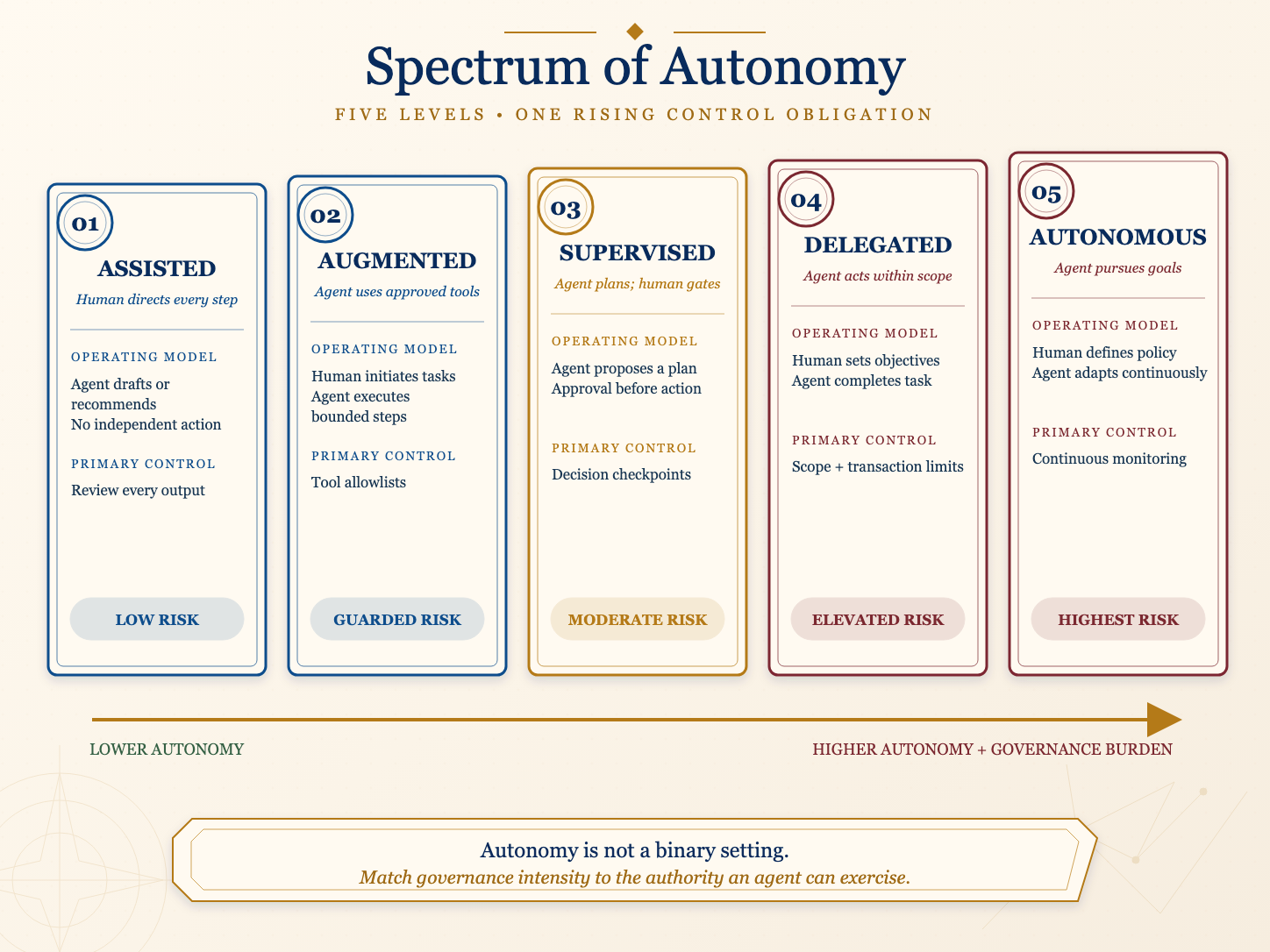
Five levels progress from assisted and augmented work to supervised, delegated, and autonomous operation. As authority rises, the human role changes from executing and deciding to approving, reviewing after execution, and monitoring by exception. Controls likewise shift from output review to decision checkpoints, scope and transaction limits, and continuous monitoring. This is not a maturity ladder but a risk-selection tool: choose the lowest autonomy that accomplishes the task, then strengthen governance as authority and consequence increase.
Takeaway. Autonomy should be selected for the task, with governance obligations rising alongside authority.
Formats
- Digital editionPDF and EPUB, sold from this site. The price will be shown at launch.
- Paperback$24.99. ISBN 979-8-953910-03-3. 6 by 9 inches.
- KindleLaunch price $4.99. The listing is not open on this page yet.
Questions
What formats are available?
A digital PDF and EPUB from this site. The price will be shown at launch. Paperback $24.99, ISBN 979-8-953910-03-3, 6 by 9 inches. Kindle launch price $4.99. The Kindle listing is not open on this page yet.
Where can I buy it?
The digital edition is sold from this site, and checkout is not open yet. Paperback and Kindle listings are not open on this page. The signup on this page sends a confirmation email for The Autonomy Brief.
What is the Reader Toolkit?
It is the page the book opens, at /books/tag/reader. The templates are listed there. The editable files are not posted yet.
Where is the self-assessment?
Take the Trust-Autonomy Gap self-assessment at /books/tag/scorecard.
Who is the book for?
Executives and boards, architects and engineers, and legal, risk, and compliance. The reading paths on this page share Part I and meet again in the appendices.